In the heart of the Venetian Renaissance, during an era when marriages were signed more for convenience than for passion, art became the herald of everything forbidden, repressed, or hidden. It was tWhen Art Painted Desire: Eternal Dreams of the Soul in the Venetian Renaissance
We must imagine the Early Modern era as a refined theater of contrasts. While marriage was often a contract of strategic convenience—a mosaic of diplomacy where spouses might meet for the first time at the altar—private reality was frequently marked by duty and silence. Yet, this rigidity dissolved the moment painting took the stage: the only space of freedom where the heartbeat could finally find its voice.
Love as a Symbolic Narrative: Venus and the Secret of Seduction
From the 15th century onward, the custom of commissioning dowry artworks—from precious wedding chests (cassoni) to inlaid headboards—allowed desire to cross the threshold of the most private chambers. Over decades, these visions liberated themselves from their functional origins to become absolute protagonists on canvas: icons of a sophisticated and cultured collectorship. It is here that Venus emerges as the eternal symbol of femininity. Whether portrayed in the solitude of her mirror or beside mythical lovers, the goddess was not merely a wish for fertility, but a silent invitation to the vital force that moves the world.
None interpreted this enchantment quite like Titian. His Venuses are not distant icons, but living presences: women capable of loving, suffering, and waiting. In the celebrated “Venus with a Mirror,” the divinity questions her own reflection in an eternal play between awareness and desire. Her body glows with a poetic, vibrant, almost sacred sensuality. Consider the “Poesie” cycle painted for Philip II of Spain, such as “Venus and Adonis”: a tragic scene where love is not enough to hold the beloved from his fate. Titian delivers an authentic sentiment that does not always triumph, and for that very reason, it appears eternal. In contrast, the “Venus with an Organist” reveals itself as shamelessly sensual—a work destined for the sovereign’s most private apartments to shield its overwhelming beauty from scandal. Here, art becomes a private confession, a forbidden dream in the secrecy of a royal chamber.
Paolo Veronese: The Scenography of Desire
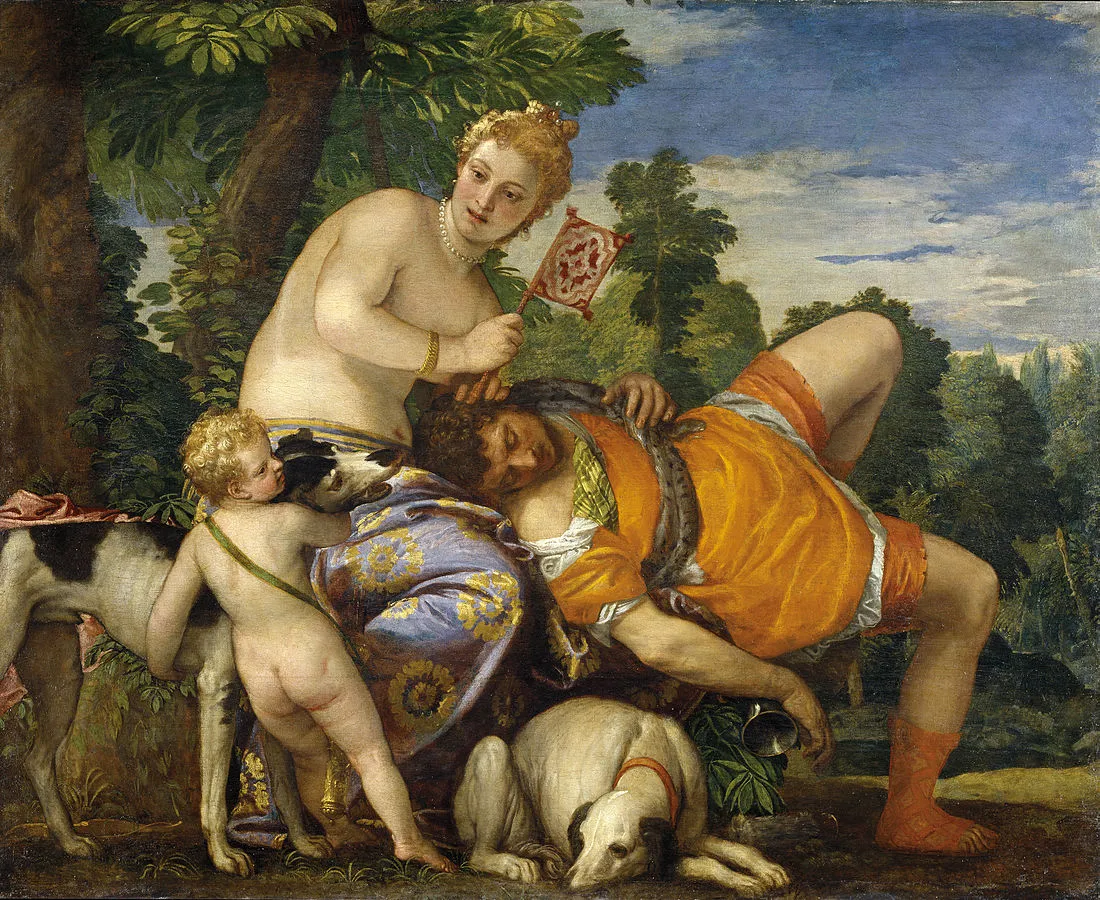
In this landscape of myth and emotion, Paolo Veronese enters as the great scenographer of Venetian beauty. While Titian paints the flesh, Veronese stages the luxury of sentiment, transforming every romantic encounter into a triumph of silvery light and precious silks. In his works, as seen in the exquisite detail of “Venus and Adonis,” desire is not merely an impulse but a ritual of supreme elegance, where every gaze is framed by the splendor of a Venice at the pinnacle of its prestige.
Lorenzo Lotto: Introspection and the Complicity of the Soul
Alongside Titian’s theatricality, the Venetian Renaissance reveals a more intimate face through the genius of Lorenzo Lotto. Where the former sought majesty, Lotto preferred cultured melancholy and introspection. In the “Portrait of Marsilio Cassotti and his Wife Faustina,” the tenderness of their complicity is palpable: not a forced pose, but a truth made of shared glances and hands entwined through time.
Lotto was an untiring investigator of the soul. A precious anecdote reveals the man behind the artist: for the portraits of Febo da Brescia and Laura da Pola, Lotto was paid thirty ducats and… two peacocks! The painter, conscious of his own worth, complained that the effort deserved at least forty. Today, those canvases are inestimable treasures—windows open to souls that continue to breathe through the centuries.
Why Do These Glances Still Belong to Us?
Because, despite the passing of centuries, the fundamental questions remain unchanged: what is love? Where does desire fade and the soul begin? The Venetian masters did not offer pre-packaged answers but visions in which to reflect ourselves. Today, standing before a Venus by Titian or a face by Lotto, we recognize a part of ourselves: a cherished dream, a lived story, a hope we refuse to abandon. Art remains, now as then, the most honest and sublime dialogue between the human and the eternal.